 Fuyang Kejin Decoration Materials Co., Ltd

Many customers frequently purchase PVC ceiling panels from us, and some have been selling them for years. These experienced customers are familiar with product specifications and pricing, but the actual PVC ceiling panel manufacturing process often remains less familiar to them. Newcomers to the industry also commonly ask about the raw materials used in PVC ceiling panel manufacturing, how the formulation is developed, and why some panels are harder or more durable than others. They also want to know why two manufacturers can produce PVC ceiling panels with similar specifications but different weights, strength, and surface finishes. At China Kejin, we have been engaged in PVC ceiling panel manufacturing for 15 years. Rather than repeating general information that can easily be found online, we want to share what we have learned from actual production and explain how PVC ceiling panels are manufactured, from raw material selection and formulation to mixing, extrusion, cooling, sizing, and final processing. Although a PVC ceiling panel may look like a simple building material, its final quality depends on many details throughout the manufacturing process, including material selection, formulation, mixing, extrusion conditions, die design, cooling, sizing, and pulling speed.
1. What Raw Materials Are Used to Make PVC Ceiling Panels?
PVC resin, or PVC powder, is the key raw material for PVC ceiling panels. Depending on specific product requirements, additional materials like calcium carbonate, heat stabilizers, processing aids, lubricants, titanium dioxide, and other modifiers are incorporated. In essence, PVC resin forms the core material while other components are added to achieve desired hardness, flexibility, weight, appearance, and processing efficiency at a controlled cost. For instance, calcium carbonate is often used to adjust stiffness and density as well as reduce production costs. Heat stabilizers ensure PVC stability during processing; processing aids enhance plasticization and extrusion performance; lubricants regulate material flow and reduce friction during extrusion. Titanium dioxide can improve the whiteness and opacity of white panels. A common misconception is that simply increasing calcium carbonate content makes PVC ceiling panels cheaper and better for manufacturers. However, after 15 years in the business, we have learned that optimizing the formulation involves more than just cutting material costs—it requires balancing hardness, flexibility, weight, surface quality, and installation performance. The locking edges are crucial; if too much filler is used solely to cut costs, the panel may become hard but less flexible, making the locking edges prone to cracking during installation. The goal is not just about increasing or decreasing material quantities but finding the ideal balance among cost, strength, flexibility, appearance, and installation efficiency.
2. Is There One Standard Formulation for PVC Ceiling Panels?
This is a frequent question from our customers. While several PVC formulations are available online—often detailing 100 parts of PVC resin mixed with specific amounts of calcium carbonate, stabilizers, lubricants, and additives—there’s no one-size-fits-all formula that every manufacturer can replicate for success. Manufacturers might choose different grades of PVC resin and calcium carbonate with varying particle sizes or surface treatments. They also utilize different additives and have unique extrusion machines, screw designs, dies, and cooling systems. In practice, we start by analyzing customer requirements like thickness, hardness, flexibility, weight, strength of locking edges, and surface finish. We then tailor the formulation accordingly. PVC resin may serve as the foundational reference point while other elements like calcium carbonate and additives are adjusted through trial runs. The precise ratios depend on the specific raw materials and equipment in use. A formulation table should be seen as a starting guide; its success hinges on how effectively raw materials, equipment, dies, and processing conditions are integrated. This variability explains why a formulation that proves effective for one manufacturer might yield different results for another.
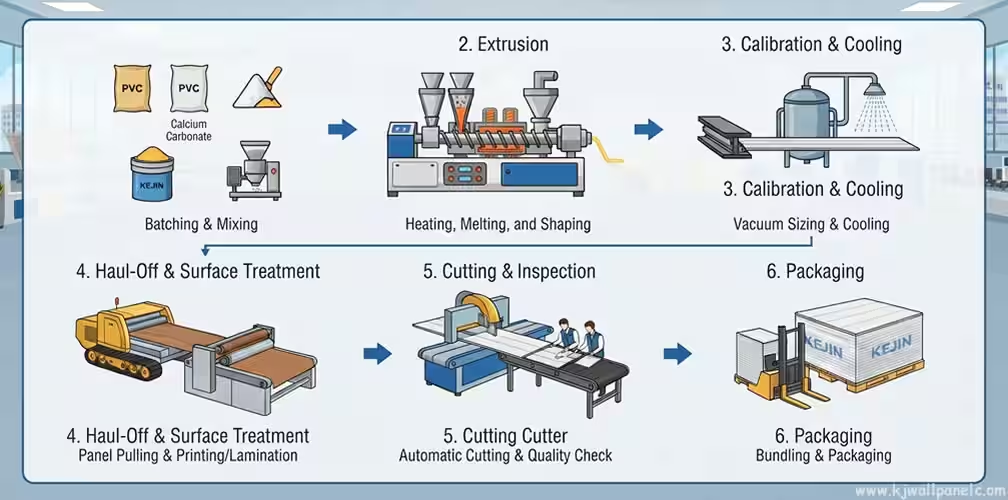
3. Mixing and Extrusion: The Real Start of the Production Process
With raw materials precisely measured according to a specific formulation, the next crucial step is seamless mixing before extrusion begins. Although it may appear straightforward, ensuring uniform dispersion of PVC resin, calcium carbonate, stabilizers, lubricants, and other additives is essential. Improper mixing can lead to issues later in extrusion, such as uneven surface texture, color inconsistencies, or particles appearing on the panel’s surface. During production, the mixing sequence and conditions are tailored to the specific materials in use. High-speed mixing generates heat through friction, requiring operators to monitor material temperature and condition rather than adhering to a fixed mixing time. After this step, the material is typically cooled before proceeding to extrusion. Within the extruder, the mixed material is propelled along the screw, subjected to pressure, shear forces, and heat. The PVC gradually plasticizes, reaching a uniform molten state before being extruded through the die to achieve the initial shape of a ceiling panel. At this stage, manufacturing experience plays a pivotal role. Optimal PVC performance is not about highest temperatures; insufficient heat might result in poor plasticization and a rough or unstable panel surface. Conversely, excessive heat or lingering material in the machine can cause thermal degradation. Signs of excessive heating or inadequate processing include yellowing, black spots, or burnt residues. Therefore, adjusting equipment involves assessing several factors: the temperature in each heating zone, screw speed, motor load, melt pressure, and the material’s actual condition post-extrusion. If a panel suddenly exhibits a rough surface, it isn’t always just low temperature at fault; issues might also arise from lubrication, plasticization, or die factors.
4. The Importance of Die Design, Sizing, Cooling, and Pulling Speed
Once out of the extruder, the PVC material enters the die that defines the panel’s cross-section—its width, thickness, locking edges, and internal structure. If the flow through the die is uneven, inconsistencies occur; one side may be thicker than the other. Emerging hot from the die, the material undergoes sizing and cooling to stabilize its final form. Sizing equipment maintains precise dimensions as cooling steadily reduces temperature. Customers often ask why a PVC ceiling panel appears straight initially but curves post-cooling. This is not always tied to formulation and can occur in actual production. When confronting such issues, it’s crucial to assess whether the die allows even material flow, if sizing remains stable, if there’s sufficient cooling, or if alterations in pulling speed exist. Ultimately, factors like formulation, die conditions, sizing, cooling, and pulling speed collectively influence product flatness. This underscores the value of experienced production operators who can discern potential problems through panel appearance and behavior, enabling them to promptly verify relevant equipment and production parameters.
5. Why Do PVC Ceiling Panels of the Same Thickness Vary in Weight and Feel Different?
This is a frequent question from buyers. While two manufacturers might claim their PVC ceiling panels are of the same thickness, customers might notice a difference in feel upon receipt. The thickness alone isn’t enough to differentiate them. Factors such as formulation, internal structure, material distribution, and the extrusion process impact the panel’s weight and density. Panels with similar thickness can have vastly different internal compositions, affecting their weight, hardness, and flexibility. Therefore, when selecting PVC ceiling panels, evaluate beyond just the price per panel or square meter. Consider dimensions, thickness, weight, surface finish, locking structure, and packaging needs. Simply comparing unit prices doesn’t suffice since panels may differ in characteristics. Long-term purchasers prioritize consistency over low cost. They seek assurance that each production batch remains consistent, that suppliers maintain stable production and punctual delivery, and that manufacturers are responsive to resolving issues.
6. Enhancing Decorative Finishes with Heat Transfer and Lamination
Post extrusion, sizing, cooling, pulling, and cutting, standard PVC ceiling panels undergo inspection and packaging. For those desiring wood grain, marble designs, or other patterns, heat transfer or lamination techniques can be applied. Heat transfer uses heat and pressure to imprint a decorative pattern on the panel’s surface, whereas lamination bonds a decorative film to the PVC substrate. The quality of the PVC substrate remains crucial at this stage. Any unevenness or impurities can mar the final appearance post heat-transfer or lamination. Hence, extrusion and surface finishing processes are intertwined; a sturdy PVC substrate is vital for an excellent decorative finish. Before shipment, panels should be scrutinized based on customer specifications: length, width, thickness, flatness, surface appearance, color, and locking-edge dimensions. Locking edges require special attention since they may appear intact but lack sufficient flexibility during installation, leading to breakage. Thus, product inspections must go beyond aesthetics to ensure the panels are practical and reliable for installation.
7. What Holds True After 15 Years in PVC Ceiling Panel Manufacturing?
With a proven track record spanning 15 years, Kejin has become a reputable name in the PVC ceiling panel industry in China. Throughout this time, we have honed our expertise from the careful selection of raw materials to fine-tuning formulations and mastering processes such as mixing, extrusion, die forming, cooling, sizing, and heat transfer with lamination. Our journey has taught us that genuine production expertise goes beyond memorizing a recipe or operating machinery; it’s about identifying the root causes of issues and making informed adjustments. For instance, if a panel warps, our first step isn’t changing the formulation. If a locking edge fails, we don’t jump to conclusions about material hardness. Similarly, an uneven surface might not just be about temperature settings. Real-time production requires an integrated approach considering raw materials, formulations, equipment, dies, cooling systems, and processing parameters.
Today, Kejin employs automated production technology to manufacture PVC ceiling panels efficiently. From the preliminary stages of material preparation and mixing to extrusion, cooling, pulling, and precise cutting, automation ensures each stage meets strict production standards. This reduces human error while enhancing efficiency, consistency, and punctual delivery. For clients, partnering with a PVC ceiling panel manufacturer transcends merely seeking the lowest cost. It involves discovering a partner capable of providing consistent quality and reliable delivery timelines.
Need Professional Consultation?
Contact our factory direct team via WhatsApp for instant support and quotation.
If you need a dependable PVC ceiling panel manufacturer or want insights into specifications, formulations, production methods, color options, finishes, or bulk pricing, Kejin welcomes your inquiry. Whether you are a distributor of PVC ceiling panels, building-material wholesaler, importer, or project contractor, feel free to share your requirements regarding dimensions, thickness, color preferences, surface finishes, and order volume. We’ll propose suitable product solutions and offer quotes tailored to your needs.
Fifteen years in PVC ceiling panel manufacturing represents more than just time passed; it embodies substantial practical know-how, process enhancement, and an in-depth understanding of our customers’ needs for a trustworthy supplier. Kejin aspires to forge enduring partnerships with customers worldwide.