 Fuyang Kejin Decoration Materials Co., Ltd

Have you ever found yourself looking at architectural plans for an international project, only to feel completely lost about the sizes of PVC ceiling panels you actually need? This is a common frustration among global importers and contractors. As you explore international markets and communicate with different pvc ceiling panel suppliers, you may notice that a size that works perfectly for a modern villa in the Middle East might not be suitable at all for a robust commercial structure in Latin America or a home project in India. Determining the correct widths, thicknesses, and weight ratios without clear direction can easily result in expensive errors. To help you navigate this confusion, this guide outlines the essential sizing requirements and key specifications to consider when planning your next overseas project.
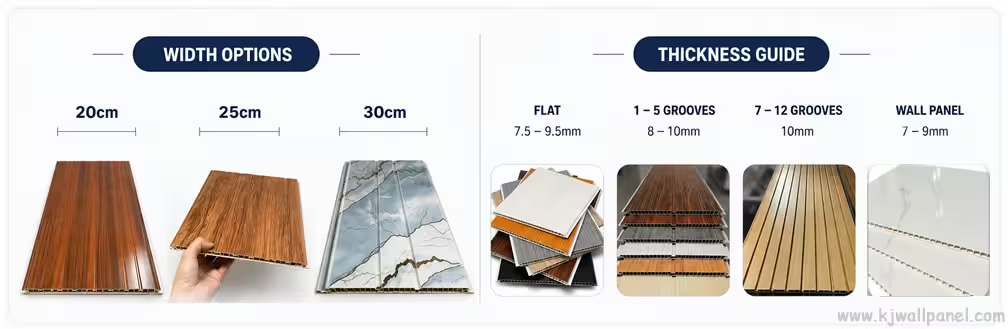
Width is a crucial specification that influences both installation efficiency and visual appeal. In international projects, standard panel widths generally fall into specific categories that cater to different room sizes and design preferences. For smaller areas, narrow hallways, or projects that need a clean linear layout with minimal joint lines, a width of 20 cm is often used. A 25 cm width acts as a flexible middle option, providing a balanced surface area that can cut down installation time compared to narrower profiles. On the other hand, the 30 cm width is recognized as the most commonly used industry standard for both commercial and residential ceilings, offering extensive coverage and fewer seams. Meanwhile, widths of 40 cm and 60 cm are usually designated for larger wall panels or specialized wide-format architectural applications that require robust coverage.
The thickness of panels plays a crucial role in determining their structural rigidity, impact resistance, and overall durability. For international projects, structural engineers and purchasers need to assess thickness according to structural needs, keeping in mind that any panel can be tailored with surface treatments such as lamination or hot stamping. Typically, residential and light commercial ceiling panels have thicknesses between 7.5 mm and 10 mm. For flat, ungrooved ceiling panels, the standard thicknesses fall between 7.5 mm and 9.5 mm, suitable for common residential uses. Moreover, 1-to-5 groove panels usually measure between 8 mm and 10 mm, while 7-to-12 groove panels are generally around 10 mm thick. In addition to standard options, these specifications can be customized; depending on the volume of orders, the Kejin PVC panel factory is well-equipped to develop and manufacture custom molds to meet specific project requirements. Larger surface wall panels also come with specialized internal structures, such as square holes, round holes, or cross-ribbing, with thicknesses ranging from 7 mm to 9 mm designed to support vertical loads.
Weight is an important factor in international trade, as it directly affects freight calculations and structural load limits. Standard flat ceiling panels typically weigh between 2.0 kg and 3.0 kg per square meter, making them perfect for lightweight framework installations. As panel designs include intricate grooves or specialized internal hole structures, the structural weight increases, with high-density panels reaching up to 4.5 kg per square meter. Knowing these precise weight ranges allows project managers to accurately estimate shipping container capacities and comply with local building weight regulations.
Manufacturing flexibility enables custom lengths from 1.5 meters to 6.0 meters to fit specific room sizes, but international shipping logistics significantly influence optimal ordering methods. To make the best use of space in standard shipping containers and reduce on-site cutting waste, suppliers and contractors often depend on pre-defined optimized lengths. For full container load shipments, lengths of 2.9m, 2.95m, 5.8m, and 5.9m are strongly recommended. Choosing these specific container-optimized dimensions guarantees tighter packing and volumetric accuracy, allowing for more square meters per container, reducing shipping costs per unit, and ultimately achieving higher profit margins in your local market.
Different regions around the world have unique preferences for PVC panel specifications, influenced by local climate and architectural styles. In Southeast Asia and the Middle East, there is a common preference for 7.5 mm to 8.5 mm flat or simple 1-to-2 groove panels, which are ideal for cost-effective residential ceilings and contemporary aesthetics. In contrast, areas like Africa, Latin America, and India often seek thicker panels, ranging from 9 mm to 10 mm, with greater density and custom surface finishes to provide better resistance to weather, moisture, and impact.
When sourcing materials from abroad, it’s essential to pay careful attention to local building regulations, weight restrictions for structures, and the efficiency of containers. If you require custom size modifications, unique groove designs, or shipping plans optimized for containers, partnering with Kejin, a dependable China PVC ceiling manufacturer, will help your project proceed seamlessly from the initial quote to final delivery. Reach out to us today to talk about your specific project needs, ask for product samples, or obtain a personalized quote suited to your target market.