 Fuyang Kejin Decoration Materials Co., Ltd

When customers ask us whether PVC panels for walls can be used in bathrooms, we usually do not start with the pattern or the price. We first want to know where the panels will be installed and how much water and moisture they will actually come into contact with. As a Fabricante de paneles de PVC para paredes, we have supplied different types of PVC panels to overseas markets, and from our experience, bathroom applications often need a little more consideration than a normal interior wall.
A bathroom is humid by nature. After a hot shower, for example, you can often see condensation on the mirror and water vapor staying on the walls for quite a while, especially when the room does not have good ventilation. The wall material has to deal with this kind of environment regularly. PVC has good moisture resistance, which is one reason PVC wall panels are considered for bathroom interiors. They are also relatively easy to wipe and clean when water marks or everyday dirt appear on the surface.
The appearance is another reason these panels have attracted attention. A bathroom does not have to look purely functional just because the wall material is practical. Decorative PVC panels can be made with marble patterns, wood grain, stone effects and many other designs. Some customers prefer a simple white or light-colored surface, while others want a stronger marble or wood effect. In a real bathroom, the wall pattern can also make quite a difference to the overall feeling of the room. A lighter marble design, for example, can make a small bathroom feel more open, while a darker pattern can give a larger bathroom a different look.
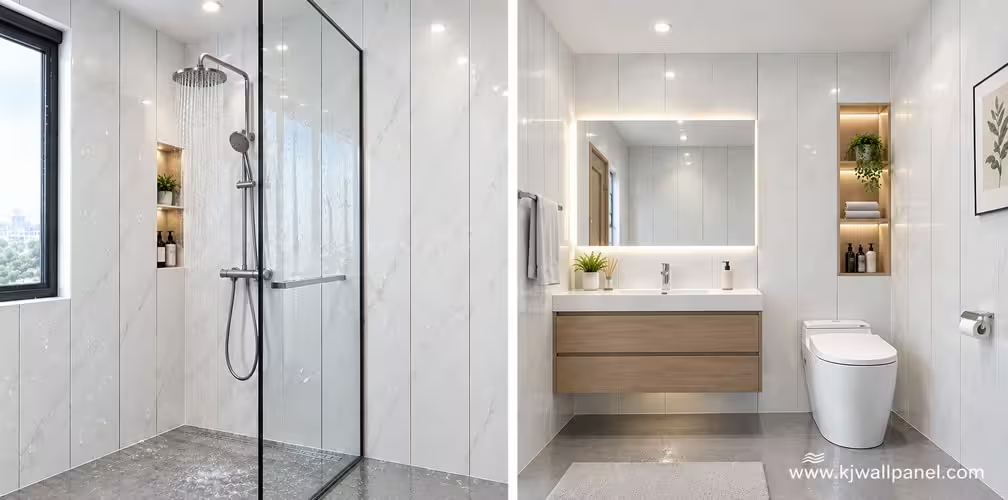
The surface treatment itself is something we recommend buyers check carefully. A product photo can look good, but it does not tell you everything about the actual panel. Heat transfer printing and lamination can both be used to create decorative surfaces, and the finished appearance can be quite different. For bathroom applications, we would also look at how easy the surface is to clean. Soap splashes, toothpaste and water marks are ordinary things in a bathroom, so a surface that can be wiped clean without much effort is more convenient for everyday use.
Installation is another reason some buyers choose PVC panels instead of traditional tiles. Our panels are installed piece by piece rather than as one large sheet, with common widths of 20 cm, 25 cm and 30 cm. The pieces are joined together across the wall, which makes it easier for installers to work around corners, pipes, windows and other areas that are common in bathrooms. When renovating an older bathroom, this can be quite practical because the installer can cut and fit each piece as needed instead of dealing with a large sheet.
That said, the panel itself is not going to fix a poor wall underneath it. We have seen projects where the customer pays close attention to the panel but not enough attention to the surface on which it will be installed. If the wall is badly uneven, it may need to be prepared first. Cutting around corners, windows, pipes and other areas also needs to be done properly. In a small bathroom, these details can be particularly noticeable because there is not much wall space to hide a poor cut or an uneven joint.
From the manufacturing side, there are quite a few things that customers cannot see from a product photo. The raw material formulation, mixing, extrusion, cooling, sizing and pulling speed all have an effect on the finished panel. These production steps can influence hardness, weight, dimensions and surface quality. This is also why two PVC panels with similar colors and patterns can feel quite different when you actually handle them.
This becomes particularly important when a buyer moves from samples to a container order. A small difference may not seem important when checking one sample, but it becomes much more noticeable when hundreds or thousands of panels are installed together. For distributors, keeping the thickness, color, dimensions and surface effect consistent from one batch to the next is especially important. Imagine a customer finishing half of a bathroom project and then finding that the same product ordered later has a noticeably different color. That is the kind of problem that is much easier to prevent than to solve afterward.
There is also a difference between the various areas of a bathroom. A wall beside a wash basin does not receive the same amount of direct water as a wall in a shower area. Around a wash basin, you may mainly be dealing with occasional splashes and water marks. In a shower area, the wall can be exposed to water much more frequently. Paneles de PVC para paredes can be suitable for many indoor bathroom wall applications, but the installation details still matter. The joints, edges and condition of the wall all need to be considered. If a project requires a complete waterproofing system, the PVC panel should not be treated as a replacement for that system.
For this reason, we normally prefer to understand the application before recommending a specific panel. The required width, thickness, surface treatment and panel structure may be different depending on the project. The local market also matters. A distributor selling bathroom materials in one country may prefer marble designs, while another market may have more demand for wood grain or simple colors.
For buyers importing from China, it is worth asking a few basic questions before placing a larger order. What is the actual thickness? How is the surface finished? What sizes are available? How are the panels packed? Can the same color and surface effect be maintained for repeat orders? These questions may sound simple, but they can make a difference when the product is being sold repeatedly in the same market.
At Kejin, we work with distributors, wholesalers and project buyers who often have their own requirements for size, color and surface design. Sometimes a buyer already has a physical sample and wants something similar. Sometimes they only have a product photo and a general idea of what they need. In either case, it is much easier to recommend a suitable specification once we know the intended application and approximate quantity.
¿Necesitas asesoramiento profesional?
Ponte en contacto con nuestro equipo de venta directa de fábrica a través de WhatsApp para recibir asistencia inmediata y una cotización.
So, can decorative PVC panels be used as a bathroom material? In many indoor bathroom applications, they can be a practical option when the panel specification and installation method are suitable. The important thing is not to choose a product based only on its appearance. Moisture exposure, surface treatment, thickness, manufacturing quality and installation all need to be considered together.
If you are looking for PVC panels for walls for bathrooms, send us the size, thickness, color, surface effect and quantity you need. If you already have a sample or product photo, you can send that as well. We can check the suitable specification and discuss the product details and quotation with you.